NaCl crystal lattice
A slice through the repeating arrangement of ions
Follow the valence electrons, connect each particle model to the material’s properties, and check your understanding as you go.
A metal atom transfers one or more valence electrons to a nonmetal atom. The resulting oppositely charged ions attract in every direction, forming an ionic lattice.
A slice through the repeating arrangement of ions
Sodium loses its outer electron and becomes Na⁺. Chlorine gains that electron and becomes Cl⁻. The attraction is between the many ions in a repeating crystal—not a stand-alone NaCl molecule.
When nonmetal atoms bond, they share one or more pairs of valence electrons. The shared electrons are attracted to both nuclei.
Corner-sharing SiO₄ tetrahedra · 3D schematic
Each carbon bonds to three neighbors in a sheet. The layers can slide, so graphite is soft and useful as a lubricant.
Silicon and carbon alternate through a strong covalent network, making SiC extremely hard and heat resistant.
In molecular substances such as H₂O or CO₂, strong covalent bonds hold atoms together within each molecule. Attractions between separate molecules are usually weaker. In network solids such as diamond or SiO₂, covalent bonds extend through a large structure.
In a simple metallic model, metal atoms contribute outer electrons to a shared, delocalized electron pool. Attraction between this electron sea and positive metal centers holds the structure together.
Delocalized electrons can move through the solid and carry electrical charge. Metal layers can shift while the mobile electrons continue to attract the positive centers, which helps explain why many metals are malleable.
Compare the common patterns in melting and boiling points, hardness, brittleness, crystal structure, conductivity, and malleability. The covalent column is split into molecular substances and network solids because their properties differ greatly.
| Property | Ionic solids | Covalent molecular solids | Covalent network solids | Metallic solids |
|---|---|---|---|---|
| Structure | Repeating 3D lattice of alternating positive and negative ions. | Separate molecules packed together; attractions between molecules hold the solid together. | Atoms joined by covalent bonds through extended sheets or 3D networks. | Positive metal centers surrounded by delocalized electrons; most metals form crystals. |
| Melting / boiling | Usually high because strong attractions act throughout the ion lattice. | Often lower than ionic and network solids. Melting or boiling usually overcomes attractions between molecules, not the covalent bonds inside them. | Usually very high because covalent bonds must be disrupted across the network. | Varies widely by metal; many have high melting points, but some are low. |
| Hardness / brittleness | Often hard but brittle. Shifting layers can bring like charges together, causing the crystal to crack. | Often soft; many molecular crystals are brittle. Strength depends on the attractions between molecules. | Usually hard and brittle. Diamond and SiC are very hard; graphite is soft because its sheets slide. | Hardness varies by metal and alloy. Many metals can change shape without cracking. |
| Electrical conductivity | Does not conduct as a solid because ions are fixed. Conducts when molten or dissolved, when ions can move. | Usually poor conductors because they lack mobile charged particles. | Often insulators or semiconductors. Graphite conducts electricity along its sheets; SiC is a semiconductor. | Usually good conductors as solids and liquids because electrons can move through the material. |
| Malleability / ductility | Not malleable or ductile; ionic crystals tend to fracture when struck or bent. | Not typically malleable or ductile; molecular solids may be soft but do not behave like metals. | Not malleable or ductile as a bulk material; most fracture rather than bend. | Often malleable (can be hammered into sheets) and ductile (can be drawn into wires). |
| Crystal structure | Commonly form ordered ionic crystals. | Molecules often pack into crystals, though the arrangement varies. | Diamond and quartz are crystalline networks; silica glass has a connected network without long-range crystal order. | Most are crystalline, though some alloys can form noncrystalline metallic glasses. |
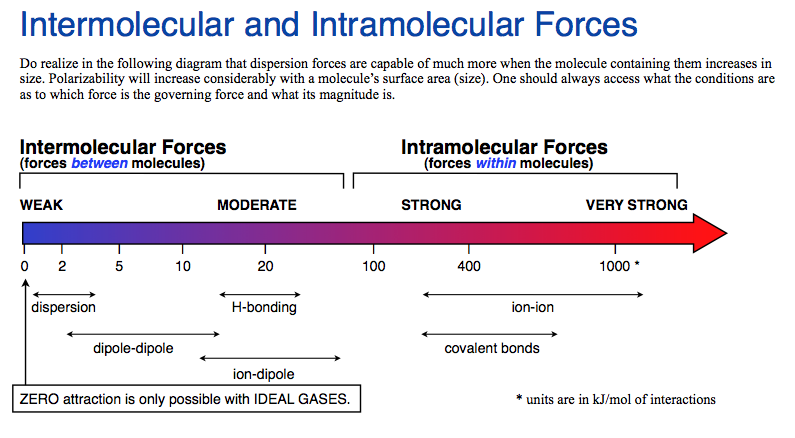
Bond strength depends on the particles and structure. This comparison helps distinguish the strong forces holding solids together from attractions between separate molecules.

Image from UT Austin CH301: Types of Interactions and its IMF help sheet.
A fresh set of questions drawn from all three sections. Answer, check your work, and try another round.